

Introduction
Continuous training for financial institutions in Africa has become a critical strategy for reducing operational and cyber risks as the financial sector rapidly adopts digital technologies. financial institutions are facing an unprecedented mix of operational challenges and sophisticated cyber threats. According to INTERPOL’s 2025 Africa Cyber-threat Assessment Report, cyber-crime now makes up more than 30% of all reported crimes in Western and Eastern Africa, costing the continent an estimated more than $3 billion in losses between 2019 and 2025.
Rapidly evolving risks often outpace traditional policies, leaving gaps that can be exploited. While robust systems and procedures are critical, employees remain both the first line of defence and a potential weak point in an organisations risk posture. Continuous training has therefore shifted from being a compliance checkbox to a strategic tool for risk management. By consistently equipping staff with updated skills, awareness, and best practices, financial institutions can reduce costly errors, strengthen cybersecurity, and operate with confidence in an increasingly complex digital landscape.
Understanding Operational and Cyber Risks in African Financial Institutions
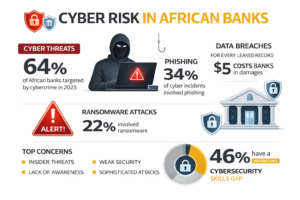
Operational risks in banks and fintechs often stem from process gaps, human error, or system failures. Cyber risks include phishing, ransomware, insider threats, and unauthorised access to sensitive customer data. In Africa, where mobile banking and fintech adoption is rapidly increasing, these risks are deeply interconnected. A single misstep, such as an employee clicking a phishing link—can lead to operational disruptions, regulatory penalties, and reputation damage.
According to the South African Banking Risk Information Centre (SABRIC), digital banking fraud cases more than doubled from about 31,600 incidents in 2023 to around 64,000 in 2024, with associated losses approaching R1.4 billion (~$78 million).
Why One-Time Training Is Insufficient for Financial Institutions
Cyber threats and operational challenges do not remain static. One-off on-boarding sessions or annual compliance courses are no longer adequate. Employees may forget outdated practices, leaving organisations exposed to preventable risks.
Continuous training ensures staff stay current with:
-
Emerging cyber threat vectors such as AI‑enhanced phishing and “quishing.”
-
Regulatory shifts across central banks and financial authorities in Africa.
-
Updated incident response procedures tailored to new attack types.
Building a Culture of Risk Awareness in Banks and Fintechs
Embedding risk awareness into daily operations is one of the most impactful outcomes of continuous training. Employees learn to:
-
Recognise suspicious activity on systems and communications.
-
Follow secure work protocols that protect customer data.
-
Understand their role in meeting compliance obligations under frameworks like PCI‑DSS and ISO standards.
Regular reinforcement of strong password practices, secure data handling, and timely incident reporting reduces human error, a major contributor to both operational failures and cyber incidents.
Enhancing Incident Prevention and Response Capabilities
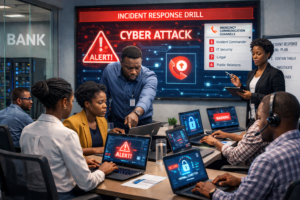
Continuous training strengthens incident response capabilities. Scenario-based exercises and simulations (e.g., phishing drills, breach response walk-through) help employees react confidently and efficiently during real threats.
For African financial institutions where regulators often require rapid incident reporting preparedness is critical. Well-trained teams minimise operational and reputational impact while protecting customer trust.
Supporting Compliance and Driving Long-Term Resilience
Ongoing training is increasingly a regulatory expectation. Central banks and regulatory bodies often require evidence of staff risk training as part of audits. Continuous learning builds organisational resilience, helping institutions:
-
Adopt new technologies securely
-
Adapt processes to evolving threats
-
Maintain customer confidence in digital services
Case in point: Banks implementing quarterly training programs reported a 20–30% reduction in internal process errors in 2023 (African Banking Risk Management Association – ABRMA).
Conclusion
For African financial institutions, continuous training is no longer optional—it’s a strategic imperative. By consistently strengthening employee knowledge and awareness, institutions can reduce operational errors, enhance cybersecurity, maintain regulatory compliance, and foster a culture of proactive risk management.
Continuous learning keeps staff alert to threats like phishing, ransomware, and social engineering, while reinforcing secure work habits. It also positions institutions as trusted, forward-thinking leaders in Africa’s financial landscape, ready to respond confidently to incidents and maintain long-term resilience.
FAQ
Q1: Why is continuous training important for banks in Africa?
Continuous training equips employees with up-to-date skills to prevent operational errors and cyber threats, ensuring regulatory compliance and safeguarding customer trust.
Q2: What types of risks does continuous training mitigate?
It helps reduce operational risks from human and process errors, and cyber risks including phishing, ransomware, and social engineering.
Q3: Is one-time training enough to prepare financial staff for modern threats?
No — threats evolve constantly, and frequent updates ensure employees stay current with the latest attack methods.
Q4: How does continuous training support compliance?
Regular training helps organizations meet regulatory expectations, including incident response requirements and cybersecurity standards.
Q5: What role does scenario-based training play in cybersecurity preparedness?
It prepares staff to react effectively under pressure, increasing confidence and reducing the impact of real incidents.
Q6: How does continuous training drive long-term resilience?
By embedding risk awareness into daily practices and updating skills, institutions can adopt innovation safely and respond effectively to evolving threats.
 Jomiloju oniyitan