
By 2026, one thing is clear: the Central Bank of Nigeria (CBN) is no longer operating on goodwill, assumptions, or after-the-fact explanations. Across Nigeria’s regulated sectors, compliance expectations have fundamentally changed.
Circulars now come with firm deadlines.
Reviews come with detailed evidence requests.
Findings come with real consequences.
For many boards and executive teams, the challenge is not a lack of intent. Most institutions want to comply. The real issue is where they currently stand in the middle of a fast-moving compliance revolution.
The End of Reactive Compliance
A significant number of organizations are still operating on outdated assumptions about regulatory supervision. They believe that:
-
Issues will be flagged early enough to respond
-
Explanations will be accepted if documentation is incomplete
-
Remediation can happen later without disrupting daily operations
That assumption no longer holds.
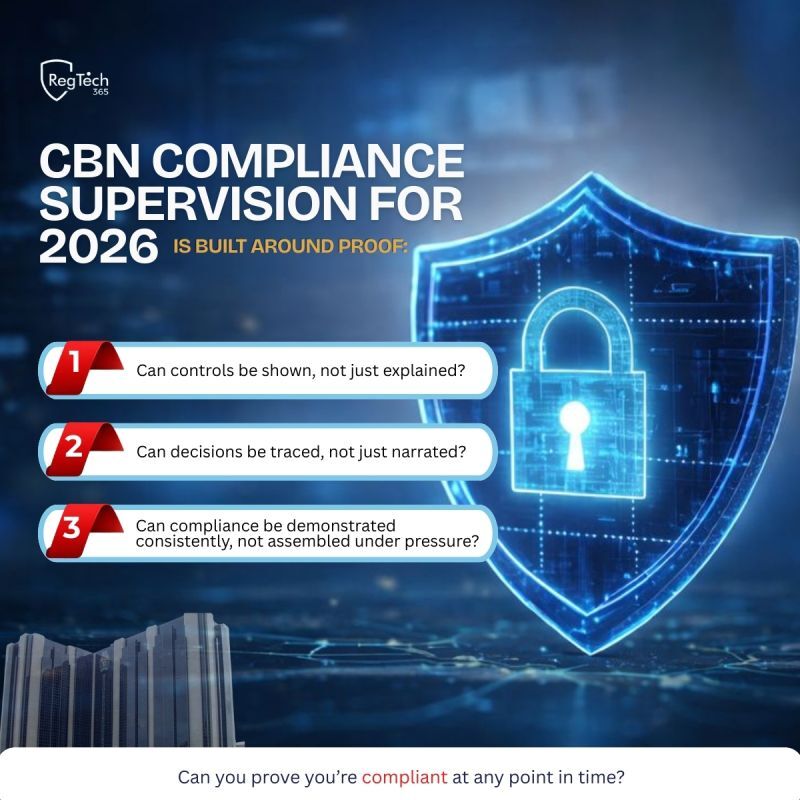
CBN supervision today is increasingly built around proof, not promises.
Regulators are no longer asking what should be happening. They are asking what is happening right now and they expect evidence.
From Explanation to Evidence
Modern supervision focuses on demonstrability:
-
Can controls be shown, not just explained?
-
Can decisions be traced, not just narrated?
-
Can compliance be demonstrated consistently, not assembled under pressure?
This shift means compliance is no longer an event you prepare for at year-end or just before an inspection. It is an ongoing operational state.
When gaps appear, the impact is rarely limited to a fine. The fallout often spreads across:
-
Core operations
-
Organizational reputation
-
Senior management time and attention
-
Investor and stakeholder confidence
In many cases, regulatory issues escalate into board-level crises not because the breach was severe, but because the institution could not prove control in real time.
Why Compliance Is Becoming Infrastructure
As a result, compliance is moving out of the “checklist” mindset and into continuous infrastructure.
Boards are increasingly judged not on whether policies exist, but on whether:
-
Oversight is visible
-
Actions are tracked end-to-end
-
Regulatory obligations are managed as ongoing work, not periodic fire drills
This is a critical shift. Policies on paper are no longer enough. What matters is operational evidence—updated, accessible, and defensible at any point in time.
The Question Boards Must Now Ask
For board members and executive leaders, the key question has changed.
It is no longer:
“Are we compliant?”
It is now:
“Can we prove it at any point in time?”
That single question separates organizations that are inspection-ready from those that scramble when regulators call.
Building Evidence-Ready Compliance
This is where structured RegTech becomes essential.
With solutions like RegWatch for regulatory monitoring and RegComply for structured operational oversight, institutions can move from reactive responses to proactive, evidence-ready compliance.
Instead of scrambling to assemble documents, boards gain:
-
Continuous visibility into compliance posture
-
Clear audit trails for decisions and actions
-
Confidence that regulatory obligations are being managed daily, not episodically
The result is a compliance posture that is visible, auditable, and defensible consistently.
A Final Question
If the CBN were to walk in tomorrow morning, what would your board actually be able to show—not just say?
That answer will define how prepared your institution truly is for the compliance realities of 2026.